Selfomy One updates simulations of all types of IELTS test questions on computers – Practice like real test
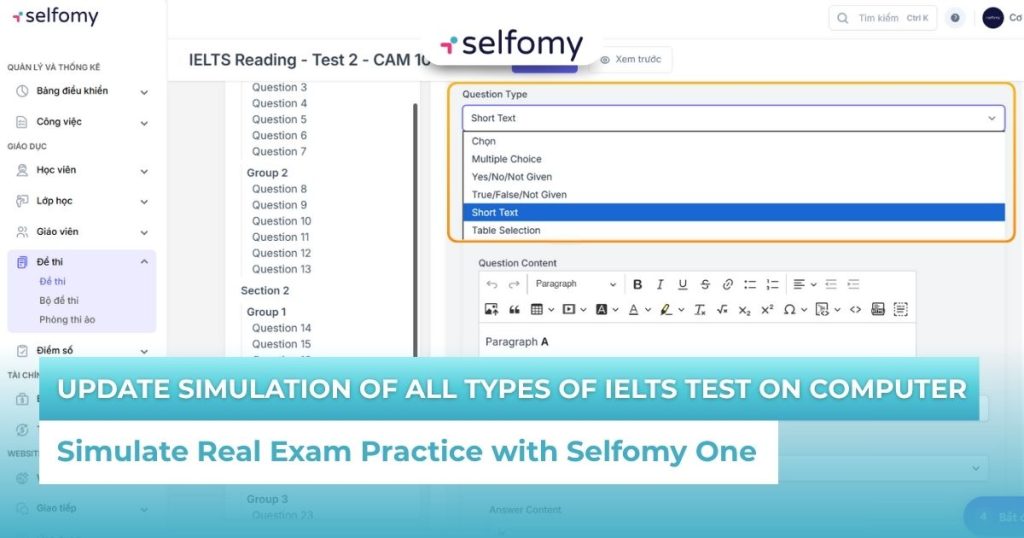
To help IELTS training centers improve the quality of practice, Selfomy One has just completed simulating all types of IELTS test questions on computers . From now on, students can get familiar with the interface and standard question formats, helping to practice for the test with maximum efficiency. Discover the newly updated test types now!
1. Why is a comprehensive computer-based simulation of the IELTS test a mandatory requirement?
Since all IELTS exams in Vietnam have switched to 100% computer-based testing, completely replacing the paper-based test, the requirements for the test preparation environment have changed fundamentally. This is no longer an option, but a mandatory requirement for students to achieve high scores.
In fact, computer-based test-taking skills are vastly different from paper-based test-taking skills, especially when it comes to complex question types. If students practice on the wrong tools, they will face serious obstacles in the real test room:
- Losing points due to confusion: Students are confused with the Split Screen interface in Reading, or are not familiar with the drag and drop/connect information of Matching exercises. This directly wastes time and leads to undesirable scores.
- Lack of familiarity with new formats: Problems like Table Completion or Multiple Answers require specific interaction on the computer. Practicing on paper cannot train the speed and accuracy of working on the computer.
Selfomy One understands that for your students to succeed, they need to practice in a 100% realistic environment. That’s why we’ve invested in perfecting the simulation of all IELTS test formats on computers – ensuring that all your students have an absolute technical advantage in the exam.
2. Details of new test formats updated on Selfomy One
Selfomy One has perfected the simulation of all IELTS computer-based test formats by updating and optimizing the interactive experience for each question type. From now on, all the types of questions that students may encounter in the real exam room are available on your platform.
Below are the newly updated groups of test types, focusing on Reading and Listening:
2.1. Completion & Gap-filling
This group simulates basic fill-in-the-blank exercises but requires high precision when operating on a computer:
Gap-filling: Ask students to fill in the correct word in the gap in a paragraph or summary.
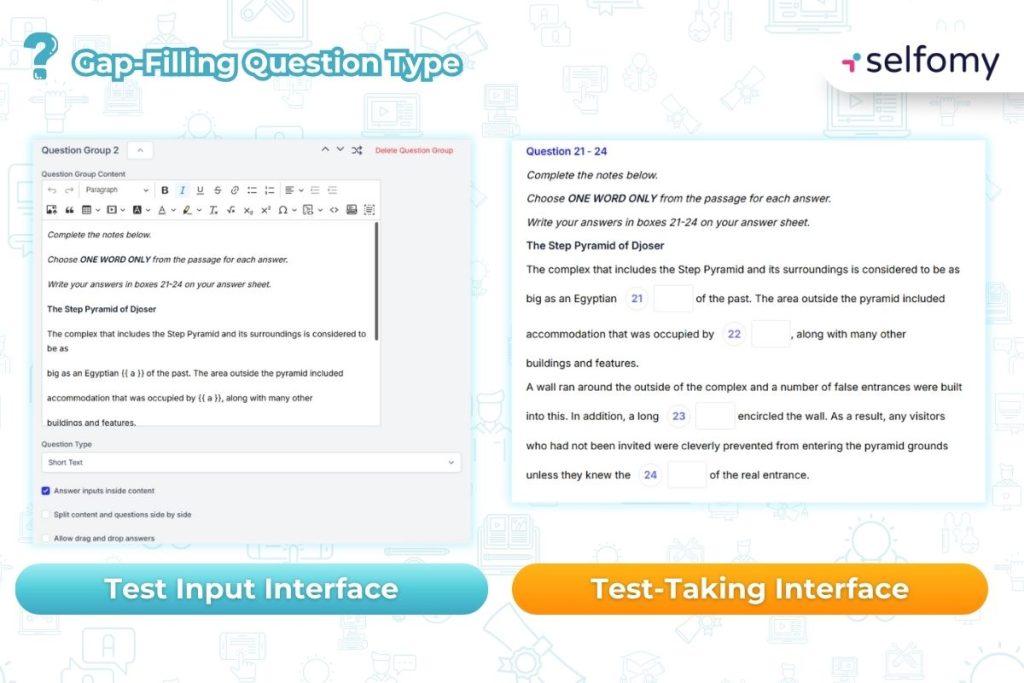
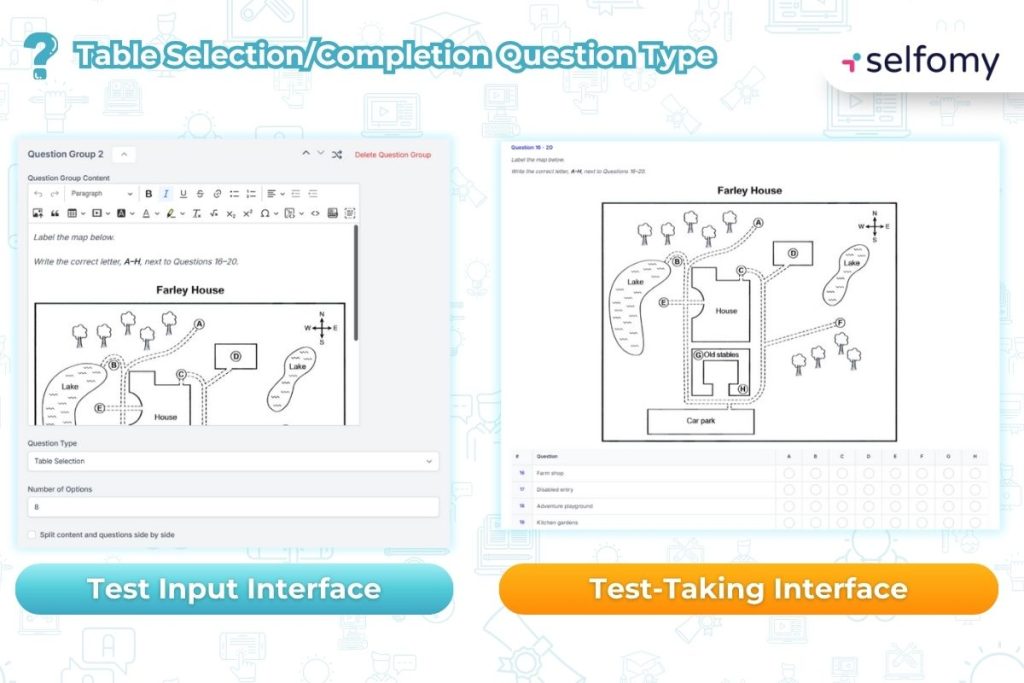
Table Selection/Completion: Students need to select or fill in blanks to complete a data table or diagram. This feature accurately simulates the input interface, helping students avoid losing points due to spelling errors.
2.2. Matching question group
This is the most complex group of questions in the computer test, requiring quick drag and drop and comparison of information:
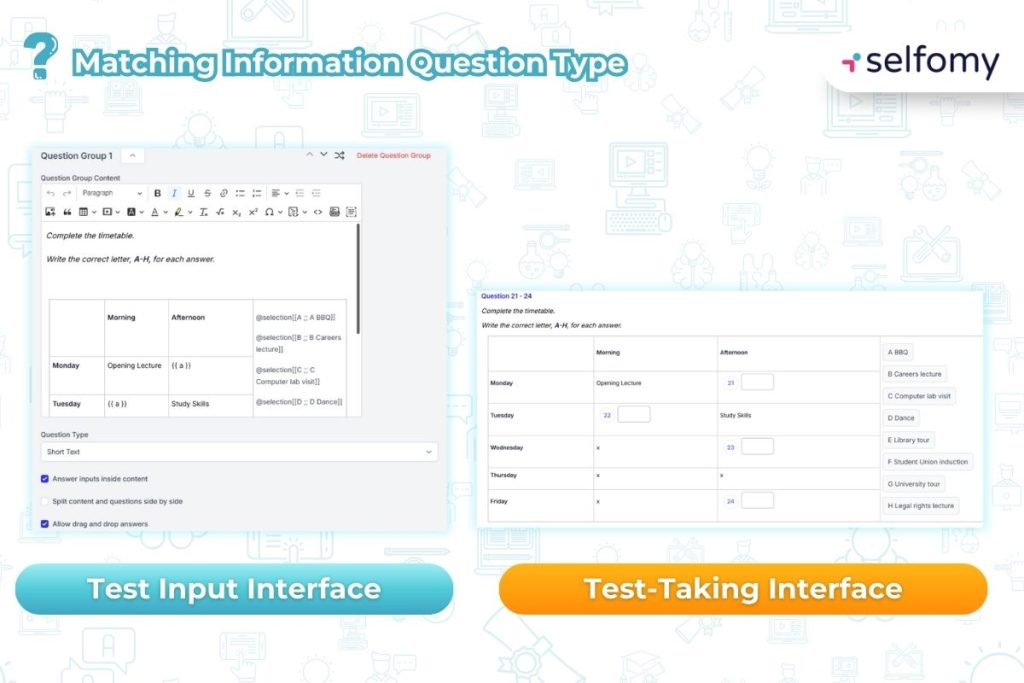
Matching information: Requires students to match a list of information/categories with corresponding statements or events. The interface on Selfomy One allows students to drag and drop or select answers intuitively, simulating the real exam experience.
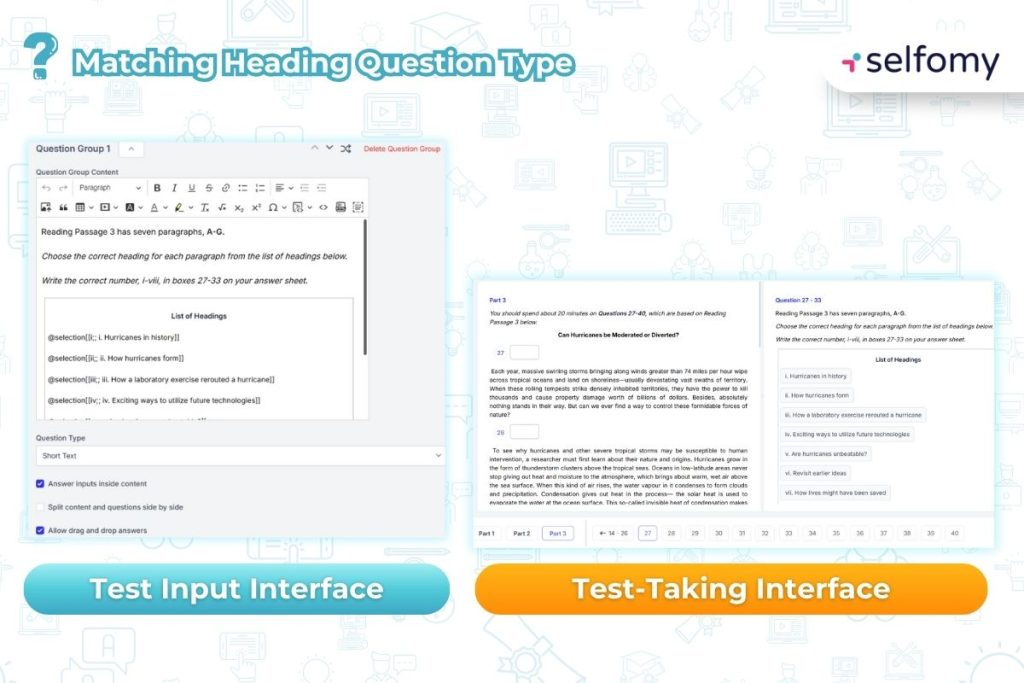
Matching Heading: An important Reading type that requires students to match headings with paragraphs. The system accurately simulates the Split Screen interface, allowing students to easily read the text and select headings at the same time.
2.3. True/False and Multiple Choice questions
These question types have an optimized interface to ensure test speed:
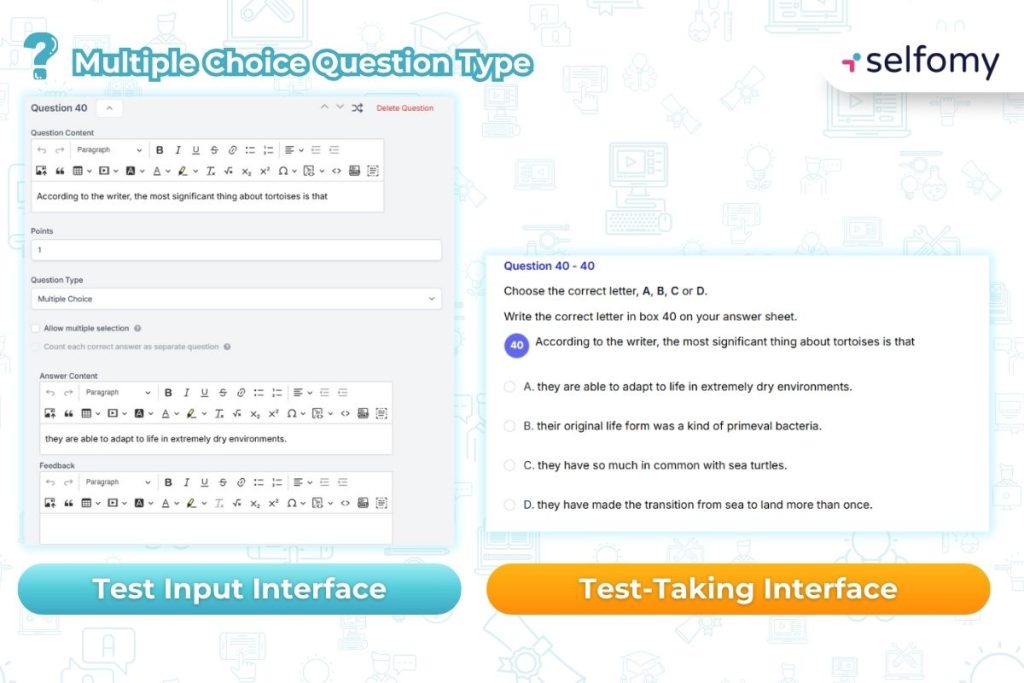
Multiple Choice Format: Refinements for quick, clear answer selection on the computer screen.
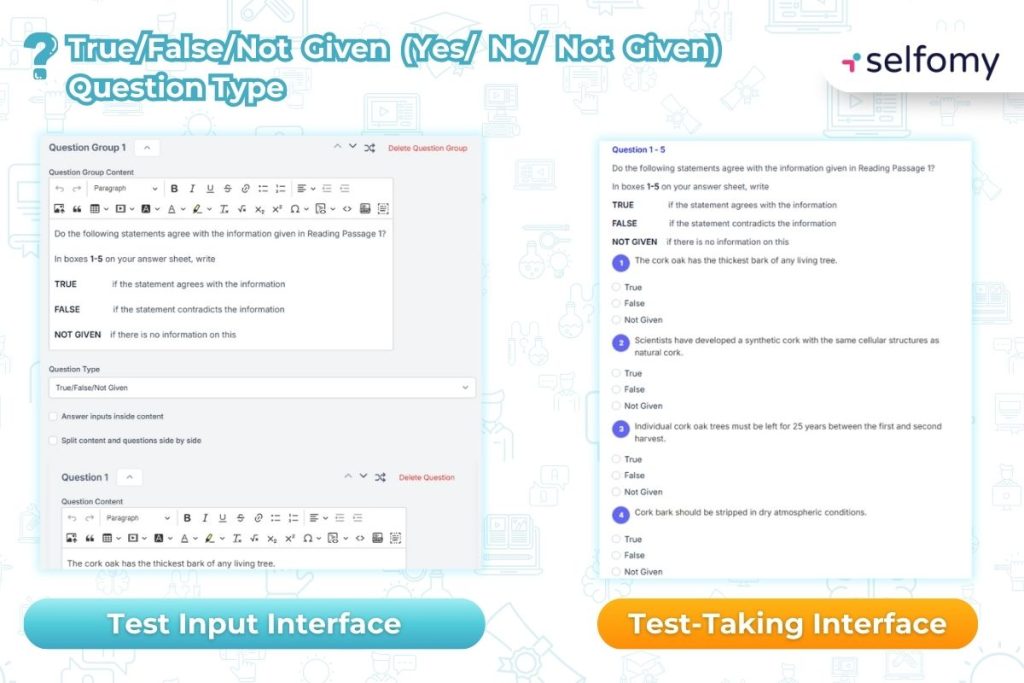
True/False/Not Given (Yes/ No/ Not Given) format: Students just need to click to select, avoiding confusion between T/F/NG on paper.
Simulating all types of IELTS test questions on this computer ensures that your center’s students are always best prepared in terms of knowledge, test-taking skills and computer operations.
3. Benefits when the center uses Selfomy One’s simulation feature
The completion of simulation of all IELTS test formats on computers brings a double competitive advantage to both the center and students.
3.1. Create a 100% real exam preparation environment
Students will not be confused about the operation on the real test day. From the countdown timer display, the split screen interface, to the way to drag and drop answers – everything is accurately reproduced by Selfomy One. Technical confidence is an important factor to help students achieve high scores.
3.2. Ensuring quality of training output
Your center can confidently declare the superior training quality because students are trained in an internationally standardized environment. This comprehensive training helps teachers easily assess whether students have mastered the specific test-taking skills of the computer-based test format. This is a way to simulate all types of IELTS test questions on computers, helping to enhance the center’s reputation.
3.3. Accurate practice data for teachers
When students practice on a standard platform, test data (test time, correct/incorrect ratio for each question type) will be collected accurately and transparently. Teachers can use this to personalize the learning path, focusing on the types of questions that students are weak at (for example, only weak at Matching Heading in Reading).
4. Conclusion
Completing the simulation of all IELTS test formats on computers is a strategic move of Selfomy One, to ensure that your center’s students are always equipped with the highest skills and confidence in the exam, which has been 100% converted to computer format.
Don’t let your students enter the exam room feeling confused just because they lack standard practice tools. Let Selfomy One become the AI-integrated LMS platform that helps your center improve training quality and build an overwhelming competitive advantage. To get started immediately, the Selfomy team has prepared detailed instructions on how to enter questions and optimize new question types on the platform at: Create test questions, IELTS entry instructions

